
Looking at things
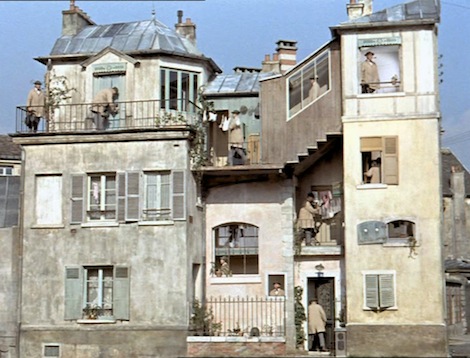
On the third day, I feel like the character in Jacques Tati’s Mon Oncle (1958) in fastforward. Writing a blog about classes taught by different artists from various backgrounds; capturing certain moments that would narrate talks and events, besides the daily acts surrounding the Fortress, call two things to my mind: Impressionism and surfing on Internet. As an impressionist I catch a glimpse of light, or say, I’m the nerd surfer constantly clicking on links and opening new windows, indefatigably scanning the screen…
The due of yesterday for the classes of Ahlam Shibli and Ben Katchor was to ‘look at things’. As Katchor pointed out in yesterday’s talk with Varda Caivano at Museum der Moderne Salzburg, a shoemaker’s approach to a certain space would differ from a baker. In a similar fashion, yesterday Shibli asked the students to go to sites without a camera, to be able to focus on details released from the pressure of pressing the shutter. In that way, the survey becomes more significant rather than immediately taking the photo, she thinks.
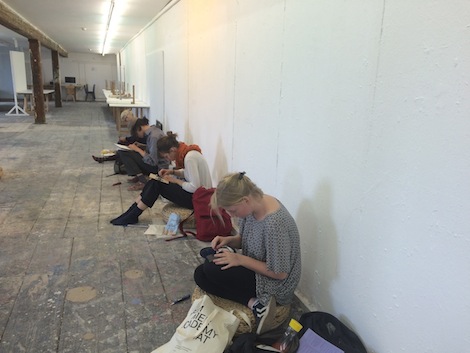
I visited Katchor’s class today. The artists explained why they chose that spot to draw and described their emotions and observations with text in their comics. Here are some notes:
-Do they start from left to right or right to leftt?
(I was thinking: what about top to bottom or vise versa?)
-Where to structure the text?
-How the text changes the information?
-the picture falling back into the realm of text
-Sometimes one has to explain what is going on behind the scenes.
-urgency of finishing and not losing yourself in details
(Katchor mentioned different approaches to detail in the classical paintings of Southern and Northern Europe. In the South the details are indicated. The artists tried to get the bigger picture before they went deeper, whereas, in the North, aggregation of details was more significant.)
-Why do I want to tell my story/show in this particular way?
-drawing within a drawing
-let the drawing fall into a landscape.
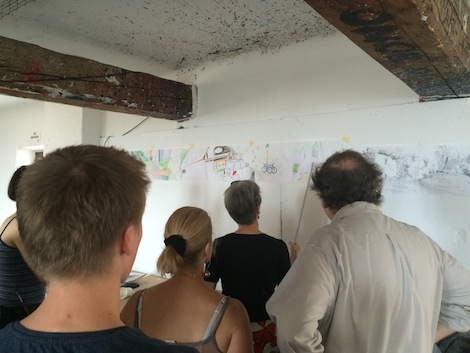
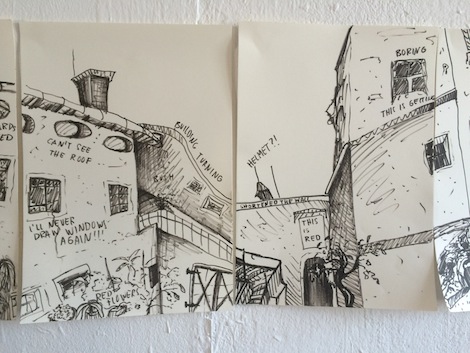
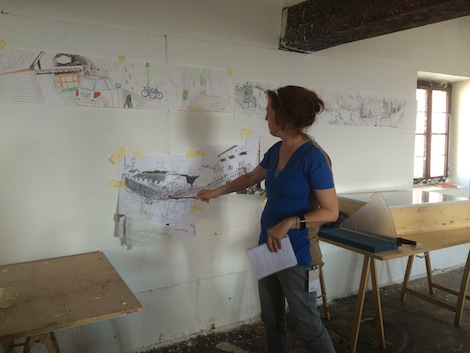
One of the artists attending to the class asked a question in her comic. As far as I remember it was like: “Why do people like views? Is it a form of ownership?” This morning, I was thinking something similar, when I’ve decided to act as a tourist before rushing to the Fortress and had a coffee at Café Tomaselli. Two years ago, when I was in Salzburg for Jennifer Allen’s writing class, someone recommended me to sit at the terrace of that particular café. I was pondering: why do people feel attracted by this terrace? Being on the second floor of the building doesn’t change the view; because of the buildings around, you still gaze down the same street. However, the perception changes as you look from above − slightly like a bird’s view or a drone’s. Funny enough, as I wanted to read more of the text The Postcolonial Constellation: Contemporary Art in A State of Permanent Transition by Okwui Enwezor that is being discussed in Alya Sebti’s class, I was looking at my screen rather than enjoying (!) the view…
Katchor’s class is called Comics in Performance. Before digging into performativity in comics and storytelling, please watch the video below Children in Old Japan 1959 Kamishibai that the artist showed at the class.
(Tomorrow: What would be the relation between gaze, notions such as 'forgetting, undoing, polyphony of voices' discussed in Sebti's class and the comic The Imaginary War Crimes Tribunal, originally created for Metropolis Magazine that Katchor performed in yesterday's talk?)
Gestures of contemplation
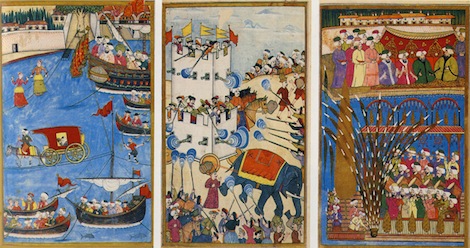
Source: Miracles in Miniature by Christine Thompson
Despite knowing some examples, my first real encounter with miniature was through two significant books of Levnî : Surname-I Vehbi (1720) – depicting a 15 days fest dedicated to the circumcision of 4 sons of Sultan III. Ahmet – and Silsilename that is consisted of Sultan portraits. What fascinates me in miniature is the use of space: there is no perspective, and the scenes are layered on top each other. Therefore, the notion of time functions differently.
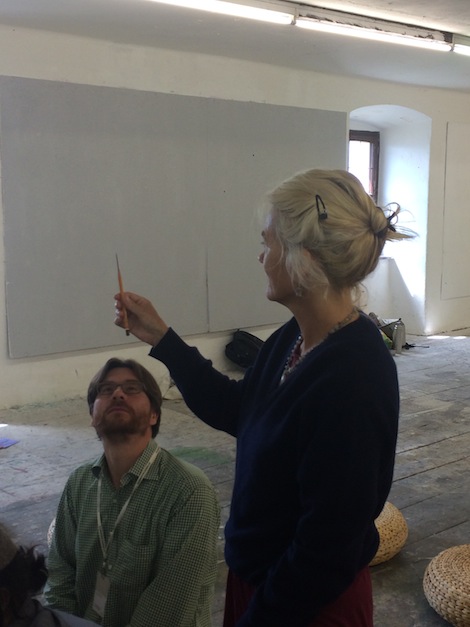
Entering the class of Imran Qureshi demands a certain pace. Here, every movement is labor-intensive and requires concentration. The timing of miniature is like being in a meditative state, as the co-teacher of the class Hammad Gillani told. Although we’re just in the second day, I can totally relate to what Gillani means.
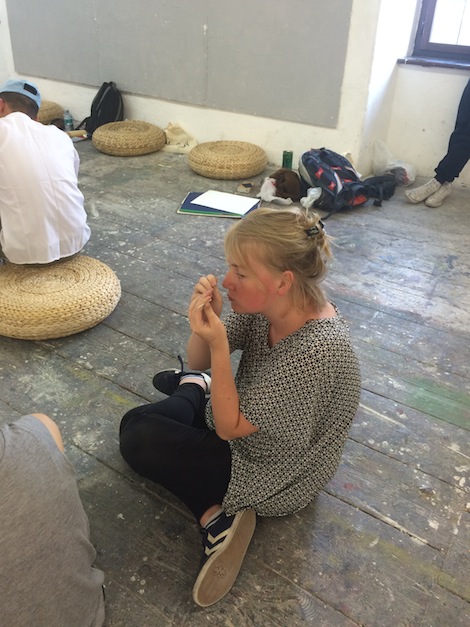
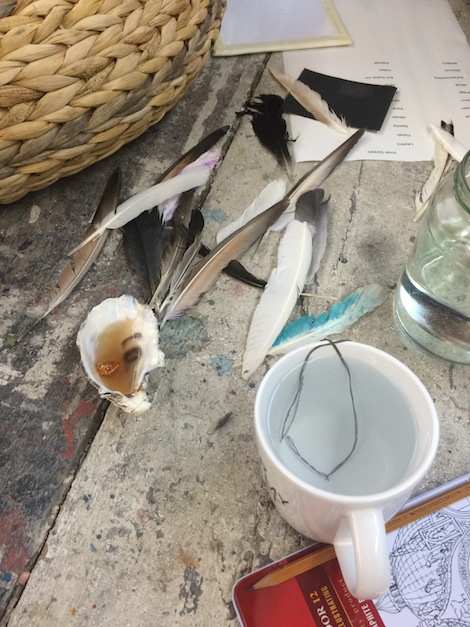
During the process of preparing the material, silence and patience is necessary. Pens are sharpened with a knife and chafed on a sand paper to have a needle like pen point. Flour is slowly boiled with water to get the glue, which will be used for the paper. The quill of pigeon feather is removed to prepare the brush. The top of the quill is cut and the membrane is cleaned out. The top end is empierced with a needle so that the feather can be stuffed through. Imran Qureshi mentioned the importance of brush for fine-line working. Through time, brush takes a certain shape according to the gestures of the painter.
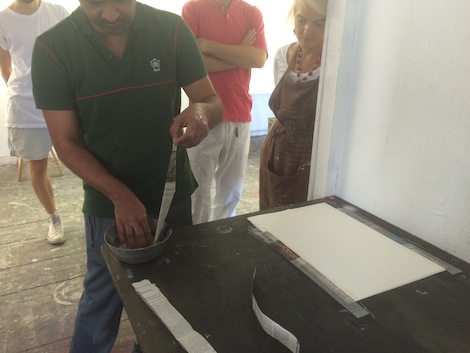

Later, 4 layers of 120-150 gr. drawing paper are aligned together. The glue is applied on top. Pressuring with hands is crucial to take out the extra glue. Stripes of newspaper are used to fix the paper on a table to avoid corner bumps after drying.
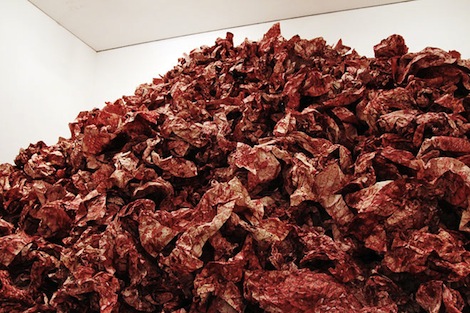
Imran Qureshi, And They Still Seek the Traces of Blood, 2013, Installation Detail Photo: Haupt&Binder
There is something poetic in miniature, indeed – Levni was a poet as well. I recall an installation of Qureshi inspired by poet Faiz Ahmed Faiz's quote: And They Still Seek the Traces of Blood (2013) that finely drawn flowers remind blood.
Sweat, streets and democracy
Grüss Gott! as they salute you in Salzburg. As you can see here is pretty peaceful:
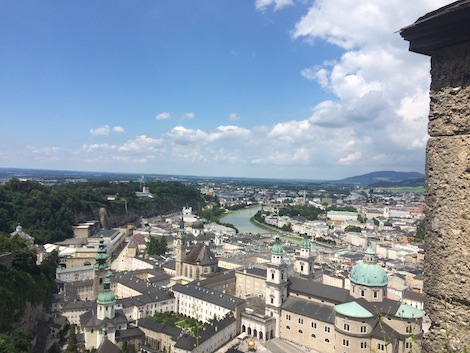
I’m Göksu, who doesn’t believe in nations, but in cultural idiosyncrasies. Despite the political agenda, the peculiarities of Turkey, where I grew up, still put a smile on my face. For instance, three years ago, our relative Aunt Tülay saw a weird building high on mountains – reminiscent of a castle – when reading my fortune through the remains of Turkish coffee in my cup. Then, months later, I got this mail from Baerbel Hartje – who later became a dear friend – if I was interested in writing about the Academy. Apparently, the castle in my fortune was the Fortress with its unique architecture. That’s how I met with the Academy and the report School of Vision was realized.
Years later, I’m here again ascending and descending the stone stairs to depict the everyday life going on in the Academy for the following 6 weeks. Classes have just started this morning. I met Didem and Demet from Turkey, taking Varda Caivano’s Painting Lab – Painting Enquiry and Lukas Pusch’s Print Print Print. Inevitably, the small talk of the first encounter transformed into a political talk on sadness and fear. As most of you already know, the coup attempt in Turkey caused quite a stir last Friday. I was at my home in Berlin, preparing for my time in Salzburg. I recall the moment that I was watching Erdogan issuing a statement via Facetime on TV. It was incredibly absurd because of the close up angle shot – almost felt like as if I was on phone with him in person. Well, I ponder if the President uses Snapchat as well…
Friends, who still reside in Turkey, have been writing on Facebook about the sounds of jet engines, gunshots and the voice of muezzins reverberating from mosques in the most unexpected hour… My eyes brim with tears when I see a specific image depicting early Saturday morning, after the fail of coup d’état. A pile of bodies with military uniforms were beaten with leather belts by the followers of Erdogan on Bosphorus Bridge (apparently, it is understood that the soldiers who are at the bottom of the hierarchy pyramid were just following the orders and didn’t even have an idea about what was going on). Although the police was around, he did nothing. Some call this scene democracy.
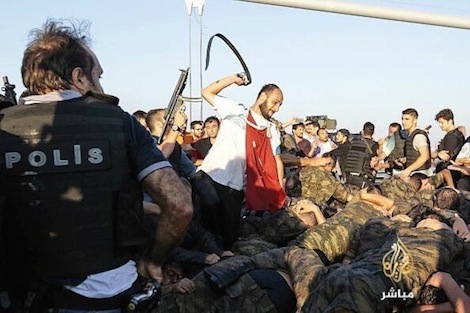
Inevitably, the topic of this year stresses the politics of EU in relation to immigration and transcultural exchange. I’m curious what the people in the Academy wandering around the white streets of Salzburg think about what really democracy is in the world of drones. I think it is sweat… We sweat whether we are a police on duty or a student in a miniature class of Imran Qureshi learning to perfectly sharpen a pencil with a knife…
Time for me to keep visiting classes… Tomorrow, I’ll be writing about miniature.
Alessio Antoniolli
The director of Gasworks and the TRIANGEL NETWORK, Alessio Antoniolli, will speak in his lecture at the “Global Academy?” conference about the development of the network, which is a community of artists and grass-roots organisations with partners across the globe. The organisation had a lot of success but also challenges to deal with. You can have an insight in the Triangel Network watching this video:
Farid Rakun
Farid Rakun is an artist, writer, editor, teacher and instigator based in Jakarta. Trained as an architect, he currently serves as editor and researcher for the artists’ initiative RUANGRUPA, while teaching full-time at the University of Indonesia. ruangrupa ist a non-profit organization founded in 2000 that examines contemporary Indonesian urban and cultural issues. In this video, he explains what ruangrupa organized and exhibited in the last couple of years. “Make friends, not art”!

