The Local/Global Studio

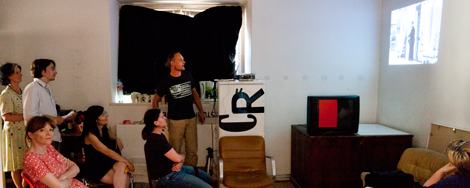
Yesterday evening saw the fourth in the Lecture Series, with a consideration of the “Global/Local Studio”. Georg Schöllhammer, curator and writer introduced he session, outlining the themes and giving us the background of the members of the panel.
The first speaker was Christoph Draeger, a conceptual artist who ran a course in the first half of the Summer Academy. He wanted to consider the theme of the local/global studio in terms of travel. As a young artist he sought a project which would allow him to travel, settling on the idea of visiting and photographing sites of disaster and catastrophe. The result was his "Voyages Apocalyptiques", taking him to sites associated with disaster throughout Europe, America and the Far East. This led to an invitation to work in New York, where he had his first "real studio" - which he also lived in - giving a new meaning to the phrase "studio flat"! Later opportunities took him to Mexico City, London, Birmingham, Warsaw, Cairo, often finding, or creating, relevant projects in in each place.
Jens Hoffmann is a well known curator and writer based in San Francisco, who recently published a book entitled The Studio. The book sought to examine the role of the studio in the production of art and as a romantic construct. The studio is much more than a place for the creation of art: recent claims for the "death of the studio" are overstated, as it has been more a case of transformation or "expansion" - even a computer can be a "studio". It has become a social and collaborative space. Hoffmann discussed the historical development of the role and function of the studio, and presented some of his own exhibitions exploring the theme. The construct of the studio, he suggested, is essential for the romantic notion of the artist.
Bisi Silva is a curator from Nigeria. She began by raising the challenging problem that while there is much information about studios in the west, there has been virtually no discussion of studios within an African context. Silva described the visibility worldwide of cultural production from Lagos, and the growth of art schools and courses, despite a lack of government support, and then turned to the introduction of western concepts of the studio by Aina Onabolu in the early twentieth century. These notions were developed by major artists such as Ben Enwonwu and El Anatsui. Contemporary practice is varied, and Silva shared images, processes and ideas from a number of young Nigerian artists with us. These examples show that we need to consider whether there is anything definitively Nigerian in these spaces and practices. She concluded by asking whether is there anything inherent about the studio beyond geography, a question we must address in the future.
Bojana Pejić is a curator and writer from Belgrade, currently working in Berlin. She is interested in the balance between "memory matters" and "body matters". Memory is undergoing a profound change, a "memorial change", as "minority memories" challenge establishment constructs of the past. These relate to the practices of art and public space. The monument as a cultural act performs a remaking of specific pasts, and plays a role in collective memory. Pejić discussed the role of memory in nationalism and the national imagination, which, she argued, centres on collective perceptions of shared suffering and defeat. Artists have manipulated monuments to comment on and critique dominant narratives, demarking them as nationalistic or sexist. These alternative memorials present an alternative narrative of the past and its relation to contemporary power structures. However, she believes that the opposition between the monument and counter-monument in recent years has begun to blur.
The talks were followed by discussion and questions, which considered issues such as studio practice as a political act, the idea of studio as “self”, and the notion of the gallery as a studio. Further ideas suggested that we should not necessarily associate the construct of the studio with either object or artist, as even legal process – as a current case in Russia suggests – can be a “studio”.

Portraits of a Working Space

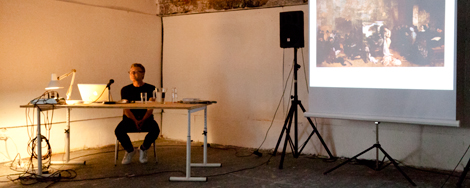
Matts Leiderstam is Swedish artist who experiments with ways of viewing. His work has included playing with gazes, making us reconsider how we interact and relate to art works. His interest in art, and ways of presenting art which challenge how we view, has taken him to think about issues such as the effect of the restoration of paintings, and the provenance of portraits of, and by, unknown people. It has also made him think about historical examples of experimenting with viewing and the notion of the studio, such as John Banvard's remarkable Panorama from the 1840s.
He discussed the role the studio has in terms of its relevance to his own work, and explained his own working spaces. His studio is a "space for thinking", it is a place where he can show his work to visitors, but also remains an intensely private space for him. His studio comprises three rooms: a "clean white room", which is a space for "hands-on" work, and a place "to think"; a "messy" office and storage room; and a computer room, a virtual studio which, he confessed, has changed his ways of working. But while the images illustrated the physical aspects of his studio, his final insistence that a studio is a space where desires and "projections concerning other plans" are made, gave us the clearest insight into his methods.
Art and Political Spaces
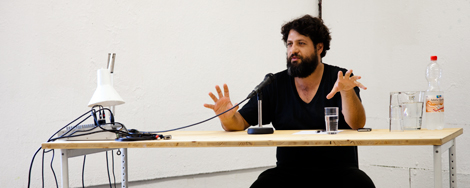
Juan Gaitán, a curator and art historian based in San Francisco and Mexico City, spoke to us on Monday about the role and relevance of art in society, and his own experiences within the world of cultural institutions. He described some of the funding problems for cultural institutions in the United States, and then the situation in the Netherlands. Having taken up a curatoral position at the Witte de With Centre in Rotterdam, he found himself in a society undergoing fundamental debate about the nature and necessity for government support for the arts. Traditionally Dutch governments have been unusually supportive of cultural projects and institutions, but a shift in the economic and political situation had led to a change in policies. Institutions were encouraged to develop new funding models which would combine public and private sources, but such ideas have been difficult to realise in the current economic climate. Indeed, Gaitán suspects that the entire debate over funding was a conspiracy to distract people from other, more threatening, issues.
These questions led to a discussion of the necessity and relevance of art in society. It was suggested that art, and in particular the space generated by exhibitions, were essential for the development of political society. Such debates always raise controversial issues, and in the climate of defensive competition caused by the funding crisis for institutions of any sort, all claims must be taken as the politicising statements that they are. But it is in these discussions that we can get to the heart of what art means in contemporary society. Gaitán certainly gave us much to think about.
The First Open Day

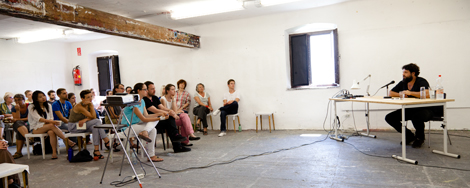
Friday witnessed the first Open Day of the Summer Academy, and with it the culmination of the first set of courses. In the evening in Hallein a reception celebrated the work of the first three weeks, but this day was first and foremost about the students. In both Hallein and in the castle in Salzburg, each course presented the samples of the work produced. The variety of artistic productions was astounding, as even within courses students experimented with the boundaries of their chosen media.
The artists who ran the courses tried to summarise the experience. Olav Westphalen, who ran the course “Jokes and their relation to conceptual art” in Salzburg, admitted that the three weeks had been exhausting: “I’m so tired”, he quipped, as I asked for a witticism to express the course. He remarked that the course had been a balancing act, negotiating the interests of teacher and student alike. It was a learning experience for both. In his teaching in art schools, the students tended to possess similar levels of knowledge and technical background. However here the diversity of students required a quite different approach, which forced him to reformulate elements of his method.

Lin Cheung, who ran the “Social life of jewellery” course in Hallein, agreed that it was both a taxing and rewarding experience. The relatively small class size led to a much more intense and intimate atmosphere than in an art school. She admits that she always learns from students, especially on how to deal with difference. Like Olav, she found the variety of students hard to manage at first, but soon developed ways to draw positives from their different ideas and levels of knowledge and expertise.
This weekend sees many leave Salzburg after a rewarding, if tiring three weeks. On Monday, the new courses begin as we enter the second stage. There is much more to come.

Studio Visits at the Künstlerhaus
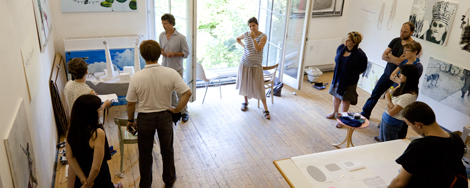
On Wednesday evening the series of local studio visits took us to the Salzburg Künstlerhaus, home of the Salzburger Kunstverein. The Künstlerhaus is one of the main centres of creative production and interaction in the Salzburg region. In association with other cultural centres, the Kunstverein provides studio space for local artists, hosts events and exhibitions, and serves as a network for artists, patrons and all those interested in the art of Salzburg.
The first studio was that shared by Peter Brauneis and Martina Mühlfellner. They allowed us to examine some of their work in progress, and explained the importance of such a working space. For them, the studio is essential not only for the practical issues of working with larger objects and storage, but also as a place to think. Bauneis admitted that he finds the space allows him to contemplate, and even find inspiration. The question of mixing with the other artists was not so important, and that for them at least, the Künstlerhaus does not really work as a meeting place for artists, in part because studio time is simply too precious - many artists have other jobs, and wish to spend the time they have at their studios working.
We then visited Fritz Rücker’s studio. Here we saw some of the practical difficulties with acquiring studio space: he shares his studio with other artists, and confessed that the impressive drum kit in the corner was not his. As they work in very different fields, collaboration is difficult, although Rücker admitted he has become more interested in collaborative projects recently. He also shared some of his recent work with us, which involved transforming media. His montage “Doors” combined footage from numerous films creating a progression of connected images, while other projects involved detailed images drawn from vast private photographic archives.