
Politics, Art and Revolution
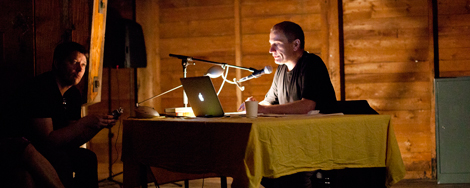
In Hallein yesterday, Peter Friedl discussed general issues which are relevant to all who consider themselves artists. Friedl is interested in the diverse ways in which themes can be represented within the context of their history. His historical focus was clear from the outset, as he teased us with the question: “What is History?” - an inquiry pertinent to any interested in the background of various artistic genres, and also a nod to E.H. Carr’s definitive volume of that name. But rather than directly tackle this question, he set about a discussion considering politics in art, and the role and reaction of the artist to revolution.
Friedl considered Gustave Courbet’s The Artist’s Studio, a work which neatly connected his general interests in the political and art history, with the theme of this year’s Summer Academy. This led to the question as to how an artist can or should react to revolution. He considered a range of figures in a variety of scenarios, such as Jean-Louis-Ernest Meissonier, Georg Forster, and Giuseppe Pellizza da Volpedo. In the examples of these figures, he drew a series of conclusions about the attitudes and responsibilities of the artist in times of political change; and, most pertinently, the many artists who used concepts of “autonomy” to excuse their postures of inaction.
His own concept of the “studio” is reading: a good book and solitude. The history of writing, and its role in human affairs, is of fundamental importance: neither the death of the author nor the birth of the reader has provided all the answers. Friedl concluded with a few thoughts on literacy, and the persistence of illiteracy around the world, wryly suggesting that “perhaps illiteracy is generating new subversive forms of intelligence”.
The Past through Place
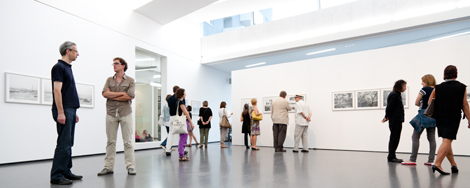
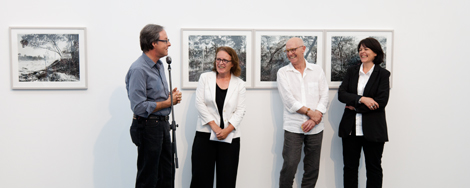
Last night witnessed the opening of Jo Ractliffe’s remarkable exhibition, As Terras do Fim do Mundo (The Lands at the End of the World), held at the Fotohof in Salzburg, and introduced by Christine Frisinghelli of Camera Austria International. Here we were confronted with a photographic exploration of the space, location and place of Africa’s longest war.
The exhibition presents a series of images Jo took during several journeys through Angola in the company of veterans of the war. These expeditions were intense experiences for both the photographer and the former soldiers, who were seeking to come to terms with what they had experienced. Angola is a forgotten war in South Africa, one played down as a “border war” at the time by the Apartheid government. There has been no support for former soldiers, and even the Truth and Reconciliation Commission sought to avoid the issue. Angola has become an imaginary space, fictions woven in the South African imagination, ephemeral and distant.
So how do you photograph ephemera? It was in the company of men who themselves were undertaking a journey through themselves as much through space, that Jo Ractliffe was able to tackle this dangerous subject. She was seeking to anchor this imaginary space in its real location, and its very real consequences. This was about finding and examining the “space” of war, a combination of landscape and pathology, touching the past through the medium of place. It took a very different way of “looking”, without preconceptions, but using at times the eyes of an artist, and at others the eyes of a soldier. The result is a series of images whose resonance lies it what happened there. These are not simply artistic representations of battlefields, nor historical documents; they are a connection to a mythologised past, and examination of conflict within its context. They are thought provoking, at times beautiful in a melancholy way. But, perhaps more importantly, they are a recognition of what happened, an attempt to come to terms. They are the past accessed through place, the distant brought near.
Photographing Spaces
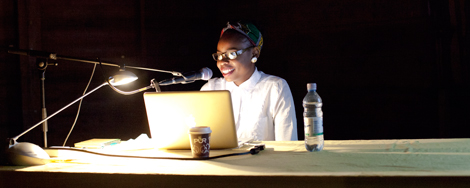
Dahlia Maubane is Photographer in Residence at this year’s Summer Academy. This afternoon in Hallein she introduced us to her work, including her involvement with the Market Photo Workshop, and the project she is undertaking in Salzburg.
Maubane lives and works in Johannesburg. Her Resettlement-Passing Housing project is a photographic comparative study, considering the ways in which students in the city’s suburb of Brixton shaped and organised their living spaces. How they form space through the arrangement of objects revealed the socio-economic factors and patterns which define the lives of many young people in contemporary South Africa.
She then turned to her current project. This draws upon her work in Johannesburg, applying the ideas to students currently studying at the Summer Academy. She also extended the study to the students’ work spaces, thus reflecting the Academy’s theme of the Studio. Such a comparative approach raises questions as to how students from very different backgrounds think and express their use of space, and whether the way they do this varies between living and working spaces. Moreover, its also makes us consider whether there are elements which tie the two spaces together. It is clear that while some students personalise their spaces, others deliberately avoid doing so, and as in South Africa, social and economic factors play a definitive role.
Maubane’s projects combine the art of photography and the principles of sociological study, presenting us with a refreshing view of both fields, and the possibilities of interaction between them.

Thinking about Jewellery

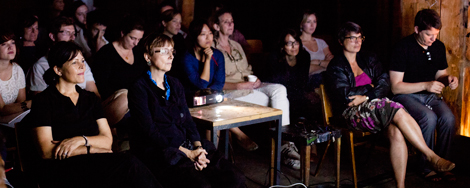
Yesterday evening the Cathedral Museum hosted an artist talk, in which Lin Cheung considered the problems and contexts surrounding jewellery art, in conversation with writer and art historian Ellen Maurer Zilioli. Lin has already described some of her ideas and approaches to her work in a Lunch talk at Hallein last week. Last night she focused on her ideas and the exhibition currently hosted at the cathedral.
Over the last few years Lin has taught at Central Saint Martins, in London, in part inspired by the arrival Caroline Broadhead as director. Such a location tells us much about the concepts which drive her work. Her teaching has centred on the “philosophy of learning creativity” and the process of creation, rather than focusing only on technique. The location itself is associated with the crafts of goldsmithery and fashion design, elements which influence her teaching. Students are encouraged to think about jewellery, and about what they can do with their training. Ultimately, it is about “asking questions”.
The conversation then turned to the current exhibition. Housed amidst the cathedral’s cabinet of curiosities, the display presents the work of students on a course Lin taught in Antwerp earlier this year. She had asked students to focus on process rather than the emphasis on final product usual in jewellery art, resulting in a series of objects which are a product of process rather than expectation. Visitors are invited to attribute definitions, names and meanings to the objects, thus initiating an interactive experience. While they do not appear to be jewellery in the simple decorative sense, they can gain - or indeed lose - such attributions by the very acts of viewer participation. It is an exhibition which forces us to think exactly how our perceptions define what jewellery is.

Producing Desires in the City

In the Alte Saline in Hallein yesterday Christoph Schäfer entertained us once more in his inimical style. He admitted he was a little “talked out” having already spoken at the opening of his exhibition, Lamentation for Ur, and at the "City is Our Factory" session last Wednesday. So today he decided to engage with some of the questions raised by the various artists and speakers over the last two weeks.
Two themes in particular had caught his attention: the question as to how to operate within political and social movements, and the problems which arise when producing art in the age of mass creativity.
He began the session by showing us a quite brilliant film in which he considered ideas of “paradise” as constructed within an area of urban space in Hamburg. Deeply satirical and ironic, his tour of these “gardens” could not avoid the comedy which his observations provided. Nevertheless, the film raises questions of how we create, consider, and appropriate these spaces. Turning to the Romantic Tradition, Schäfer drew upon Hogarth’s concept of the “line of beauty” and its realisation in the work of Capability Brown: in the Romantic garden, “everything is transformed into art...a totality of aesthetics”.
Such notions can apply to the image city of today and the possibilities which exist to appropriate space. Here we can see ways in which art can “dissolve into reality”. Schäfer gave us two examples of the highly politicised “production of desires” taking place within urban spaces. The first concerned Hamburg residents’ ultimately successful battle to save an area of St. Pauli from developers and create a space for people. The Park Fiction Collective proved ways in which art could intervene in wider life. The second example concerned the attempt to save the Kukutza Gaztetxea youth cultural centre in Bilbao. While the campaign may have been unsuccessful, the astounding film they produced remains a testament to the remarkable vision and talents of those involved.
As ever, Christoph Schäfer entertained as he informed, a talk which was artistically and politically aware, sophisticated without ever talking down to his audience. There is much to be learned here.


