
Political Art and Action
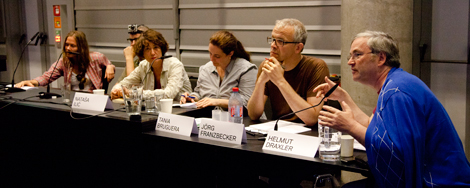
Friday night witnessed the third of our lecture series, and perhaps the most intense so far. Entitled “Political Interventions and Working in Collectives”, the session brought together artists and activists, for whom the political is the central aspect of their work. The panel was chaired by Helmut Draxler, an art historian, critic and curator from Berlin. He highlighted the issues surrounding the links between art collectives and political actions, and asked whether it is the artistic practices, or the goals, that are political.
The first speaker was Nataša Ilić, a founder member of What, How & for Whom (WHW), a collective formed in 1999 in Zagreb. She outlined the politicising origins of the collective, and the political and social forces at work during its inception. The founders sought to challenge prevailing narratives, such as the notion of a “year zero” with the founding of an independent Croatia. She then described some of their key projects: the 2005 project, “Collective Creativity”, investigated the ways collectives acted and interacted within the context of social and political forces; the 2009 exhibition “What Keeps Mankind Alive” drew on Brecht’s notion of ownership in society and “communist hypotheses”; and the “Details” exhibition (2012) considered the rise of contemporary fascism.
Joerg Franzbecker, a freelance curator from Berlin, considered the ambivalence, and varying forms, of collectives, and their appropriation of space. His approach, he insisted, was based on experience rather than any theoretical standpoint. He considered some examples of collectivity and concepts drawn from Kafka and Gerald Raunig, before turning to a collective in which he is involved. The Haben und Brauchen (To Have and To Need) collective published its manifesto this year. They seek collective group action, and produced an open form manifesto which allowed the forty-plus contributors to be heard in their contrary and individual forms. In this way, they hoped to emphasise the “singularity within the whole”.
The third speaker was Yana Sarna, accompanied by Alex Pluster-Sarno, members of the Russian art collective Voina. Sarna outlined the principles of the group, which produce “protest radical street art”. She showed clips of their “actions”, which mainly appeared to be directed against the Russian State Security Services. The most radical of these actions included painting a giant phallus on the Liteiny Bridge in St. Petersburg, and overturning police cars. Several members of the collective have been arrested, prompting the collective’s Europe-wide campaign to heighten awareness of the fate of “political prisoners”.
Finally Tania Bruguera described the political aspects of her work. She critiqued notions of “left” and “right” as being no longer applicable to contemporary politics, seeing now as a moment for new political definitions. Her aims are ambitious: to generate an art which is understood by politicians, an art which goes beyond the art world, and can transform viewers/participants into active citizens. For her, the collective is the public itself, and they are integral to political change.
The panel was followed by a lively discussion, which reflected the passionate nature of the subjects. Issues such as the internal dynamics of groups, and how audiences can relate to collectives were raised. There were also some voices of warning: what happens beyond temporary collectivity? Are artists manipulating audiences, and thus reflecting the very totalitarian practices they seek to dismantle? The most severe criticism came for Voina, and their apparent use of a young child in some of their actions. They describe the child as an “activist”, but some audience members felt that the child himself was being used and placed in highly dangerous situations. In response, Pluster-Sarno declined to engage with the questioners, claiming such issues “did not interest him”, and that he was not concerned with the questioner’s opinions. The entire session highlighted the fact that freedom of expression is both a complicated, and a sensitive, issue.

The pad.ma project
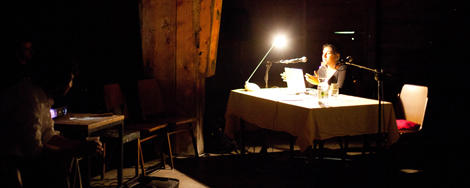
Friday’s lunch talk in Hallein highlighted the work of Shaina Anand and Ashok Sukumaran, founders of CAMP, a collaborative project based in Mumbai. Shaina began with a description of pad.ma, a phenomenal project of which CAMP is a co-initiator.
pad.ma is a project which involves the creation of a vast online repository for digital film material. The rise of digital technologies has enabled documentary film-makers to shoot large quantities of footage much more cheaply than before. The majority of the footage - often as much as 99 per cent - never makes the final film. But this unused footage is the archive of contemporary society and life. pad.ma seeks to give access to this vast quantity of material, and has approached film-makers to share their unused footage. This footage is then text-annotated to create a searchable archive covering every aspect of modern life.
An extension to the project has involved digitalising part of the collections of Afghan Films, the national film institute of Afghanistan. Through the courage and initiative of various curators the collection survived the ravages of the Taliban, and is now being made accessible to the world.
The speakers went on to describe further projects associated with CAMP: Shaina described a project based in Jerusalem, The Neighbour Before the House, and Ashok told us about his Wharfage project.

“How She Boogalooed It”: Helen Schoene’s Unpicking through repetition
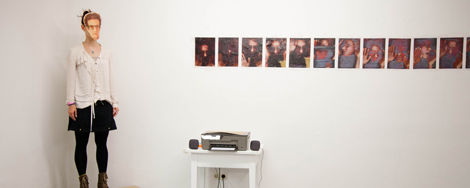
The opening of Helen Schoene’s exhibition, Unpicking through repetition, at the Galerie Eboran in Salzburg on Thursday, was a performance in more ways than one. She “performed” the introduction, playing the role of Matthew Webber, whose talk considered notions of “partition” and “repetition” in historical, etymological and philosophical modes. The performance itself was self-repeating, playing with the audiences’ concepts of original and imitation. Every art work, is a “representation” or a “repetition”, as the “reality is always receding into the past”. But this also highlights the absurdity of the very notion of originality, resulting in “a hundred million different version of reality, all of which are real”.
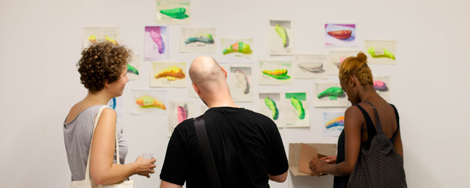
Schoene’s work examines concepts of repetition and imitation, representation and inspiration. Her art includes drawing, paintings, prints and photocopies. By its very nature it is hard to define. One wall presented the viewer with numerous copies of an image of a vegetable, each coloured differently, and each accompanied by a seemingly random text. But the texts were not so random: they were song lyrics, taken from such classic masters as Dion, the Shangri-Las, and the Beach Boys. And they carried a resonance which belied the simplicity of the images. As Al Jardine sang, “Oh my, how she boogalooed it to me”.
Studio Visit: Konrad Rainer
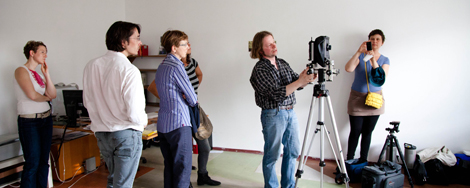
On Thursday evening the series on local artists continued with a visit to the studio of Konrad Rainer.
Rainer is a Salzburg born artist whose work, while based on photography, also draws on other media, including painting. It is often conceptual, ranging from subtle portraiture style pieces playing with our expectations, to overwhelming complex vistas which border on the Daliesque. His work has been exhibited around the world, including Sicily and the United Arab Emirates, and can currently be seen at Salzburg airport.
He explained his workspace and gave us insights into his methods. His preference for analogue film plays an important role in his work, allowing a melding of photography and painting which would not work - or at least be very different - in digital media. Perhaps most interesting for many was his equipment, which revealed both the complexities and yet also the startling simplicity of his methods.

Seriously Comical
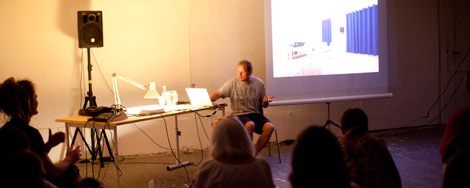
Olav Westphalen entertained us on Thursday lunchtime with accounts of his work, which embrace performance and the conceptual, often darkly comic and always thought-provoking.
Westphalen also works as a cartoonist for the mainstream media, revealing his understanding of popular humour and expectation, features which repeatedly emerge in his art. He shared some examples with us: his attempt to walk on water at Santa Barbara, California, was one of many performance pieces which tested the nature of public expectation. It expressed the comical - his attempt was aided by a preposterous array of flotation devices - and its ultimate failure became its most enduring quality. Such acts cannot, he insists, be practiced or repeated, because then they would become “theatre”, they would be staged, with a predestined outcome. The element of “failure”, moreover, cannot be contrived - it must be genuine to have any meaning.
Other projects have played with constructs of public expectation, performance and politics. His tree house in Kassel, which was too large to fit through the entrance of the museum, was, he claims, a “failed sculpture” - but nevertheless a “good enough sculpture”. Indeed, it became a “focus for local political expression” as it lay outside the museum. Far from failing, it garnered its significance because of the unique congruity of the expectations of what an artwork is, and the fact that it was, at the same time, the product of some guys “having fun in the forest”.
At times his work is both political and satirical: the Flip Flop Factory in Shanghai, or the brilliantly conceived Fertility Coop, function on many levels. His suggestion that art should not be taken too seriously reveals the comic elements which underlie his work. Often it is, quite simply, funny. But this humour also intensifies the serious, or at least politicising, elements. These features are integral to one another. His Extremely Site-Unspecific Sculpture (E.S.U.S.), exhibited around New York in 2000, was a deliberately ambiguous, and yet strangely utilitarian piece, exploring the problems built into objects. That it was mistaken by local drug dealers as a CIA listening device, just shows ways in which such art can provoke, and still, in the retelling, make us laugh.


