
preparations
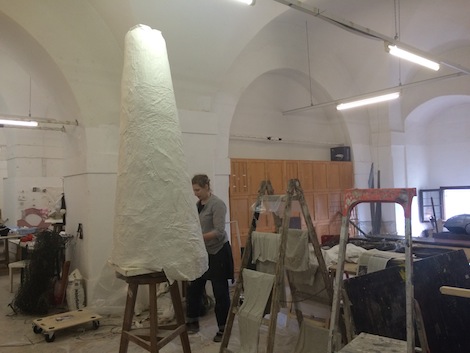
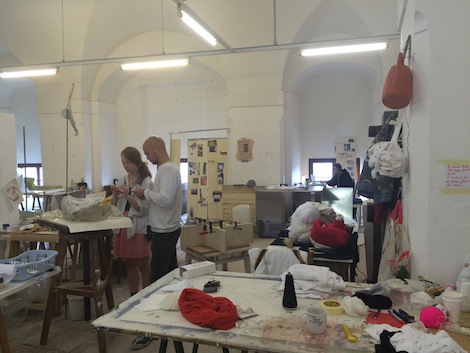
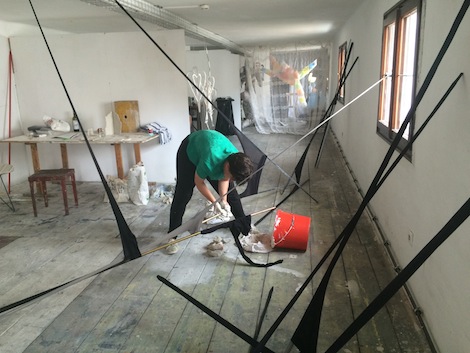
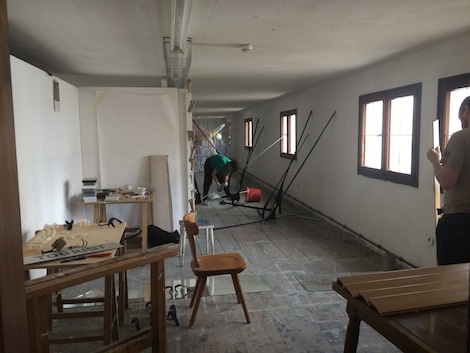
Meanwhile in the Fortress... Images from Nora Schultz's sculpture class When Sculptures Walk Out.
The question of ethics

Helmut Draxler’s text Showing Nothing: The Ethics of Institutional Critique flirts with dualities such as ethical-unethical in order to create a wider, say, almost rhizomatic understanding of the issue. During the Skype meeting with the art historian/curator the class of Joanna Warsza raised their questions in relation to the afore-mentioned text. As Draxler pointed out, moral is bound to norms and rules and create the violence in order to realize the ideal. Whereas, ethics includes its opponent to the equation: “unethical is in the ethical.”
Draxler mentioned the fact that as curators working with institutions there is no escape from the unethical. Moreover, he believes art should intermingle ethical with unethical. The curator pushes it even further and suggests embracing the unethical as artists rather than trying to be ethical; for him the negotiation between ethical and unethical is crucial. Draxler defines ethical as the assimilation of acts that are considered ‘ethical.’
The art historian drew attention to the “welcome culture” for refugees in Europe. Despite the fact that it’s crucial to create spaces for refugees, without solving the real problem on a political level, such a culture wouldn’t end this violence. On the one hand, it’s amazing and so important what people are doing. On the other hand, there is another aspect of it: “they do it for their bourgeois moral, which cannot solve anything.”
Well, nothing is black or white. Furthermore, again who decides what the ethical is?
At lunch, I was talking with Ahlam Shibli about her series Eastern LGBT (2004-2006) with LGBTQI members, who were born in the East but living in different parts of the world to create a new home, where they can freely fulfill their needs. For most of the people being a queer, going beyond the binaries of woman-man and loving each other regardless of gender is unethical and amoral. I told Ahlam that I’m queer as well and we talked about the problematics of nuclear family structures, reproduction and how it is forced by states so that ideology of the nation or the religion is passed on to the next generation – let’s not forget the economical aspect of a family, how consumerism is accelerated…
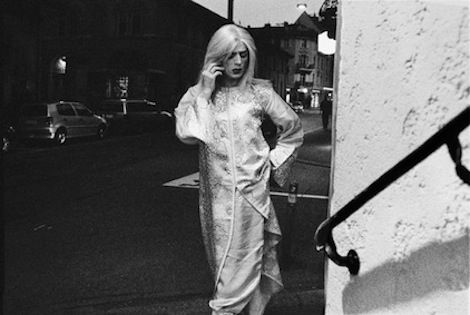
Ahlam Shibli, Eastern LGBT International, 2004 / 06
series of 37 photographs, 37.8 x 57.6 cm; 57.6 x 37.8 cm; 70 x 100 cm; 100 x 70 cm, gelatine silver prints; chromogenic prints
censorship
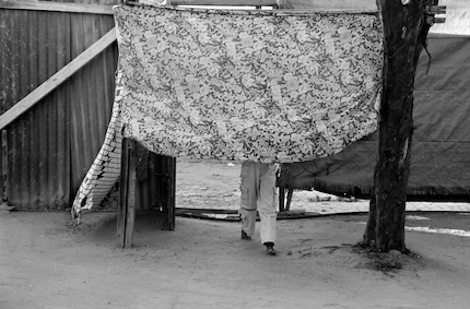
Ahlam Shibli, Goter, Al-Naqab, Palestine, 2002–03
series of 44 photographs, 38 x 57.7 cm; 57.7 x 38 cm, gelatine silver prints; chromogenic prints
Due to the censorship in Holywood on kissing longer than 3 minutes in films, quick-witted Hitchcock created his own tactic for Notorious (1946). Looking out to a beach in Brasil in a fancy flat, Ingrid Bergman and Cary Grant start kissing. After exactly three minutes, they briefly stop, whisper into each other’s ear and continue to generate tension. The scene lasts two and a half minutes.
From “Degenerate Art” to jailed journalists of Turkey, bans on the works of writers, journalists and artists have a long history. Ahlam Shibli and Joanna Warzsa had to deal with censorship as well in different parts of the world. In the talk Art and Censorship on last Tuesday, Shibli touched upon a problem she faced years ago in Tel Aviv Museum because of her nationality as a Palestinian and bomb threats to Jeu de Paume during her retrospective, due to the content of images depicting photos of martyrs in the homes of Refugee Camps in Palestine. It should be stressed that the artist’s main concern is to give visibility to problems that are put out of sight by a certain power rather than taking a side. Shibli’s works mostly contemplate on the idea of home, revolving around the notions such as the right of calling somewhere home or exclusion of representation.
A Christmas tree that is usually identified with cozy gatherings might create vigorous tension as in the case of Manifesta 10 that Joanna Warsza talked about. Kristina Norman’s installation Souvenir (2014) − a part of the work also consists of a video, Iron Arch − recalls the Christmas tree of Kiev’s Maidan Square that became a political symbol during the Ukranian Revolution in 2013. Because of its political resemblance the green metal structure generated a problem and unfortunately, the work was removed. In the talk, the curator mentioned the strategies they had to come up with to resist such a censorship.
Jonas Stahl’s The New World Summit (2012) − exhibited as a part of 7th Berlin Biennial – the installation questions the notion of democracy formed by states and exclusion of ideas by labeling them as terrorists. The installation was displaying the flags of the so-called terrorist (!) organizations, which, of course, didn’t please certain authorities at the end...
Well, tomorrow I will continue with the Skype meeting of the curating class with the art historian, art critic and curator Helmut Draxler.
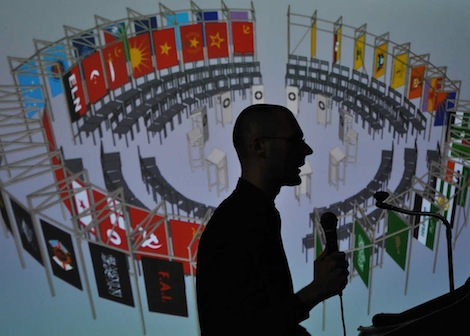
Image source: DAI
Dancing in the Urban Setting
The class Public Space by Feld72 take place in an abandoned military barrack that is soon to be demolished. Students, who are coming from various fields such as sculpture, dance or architecture, research the dynamics of public space. Some analyze street signs and their impossibility in terms of bodily postures or dance with urban objects such as bike parks, whereas the others look over the nomadic space created by the street vendors or the flow of speed in the city and the obstacles occuring as a result or the personal objects left in public spaces. While talking about the codes of behaviour and (un)written regulations of public space, teacher Micheal Obrist mentioned the video Ministry of Silly Walks by Monty Phyton.
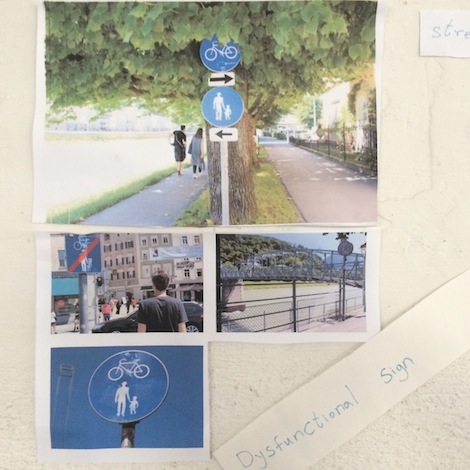
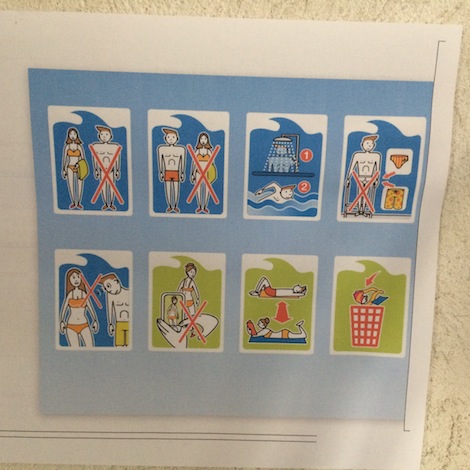
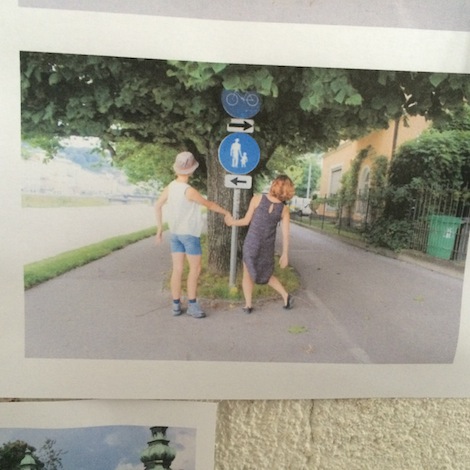
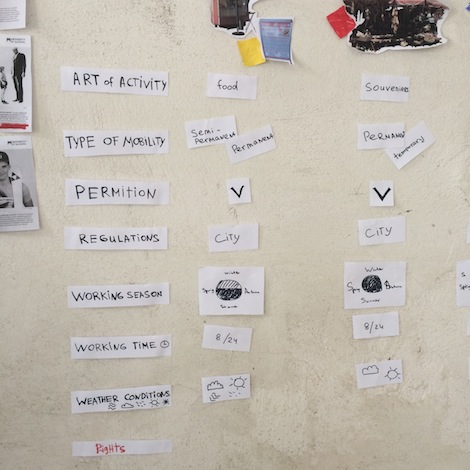
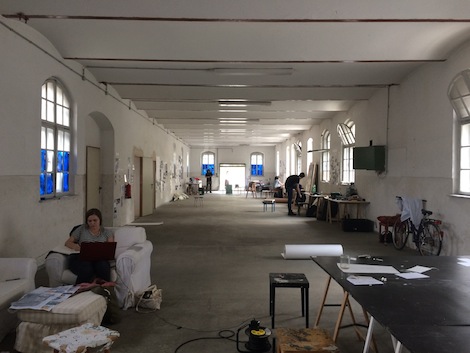
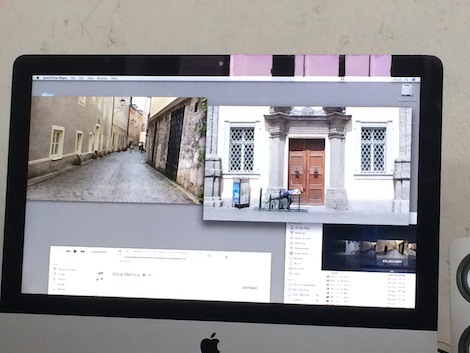

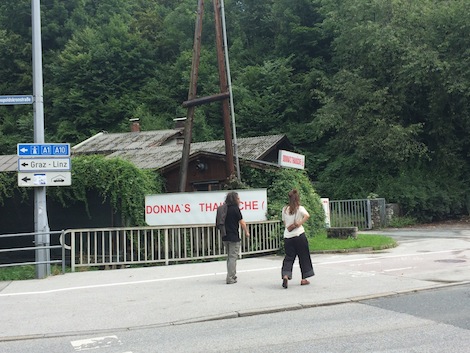
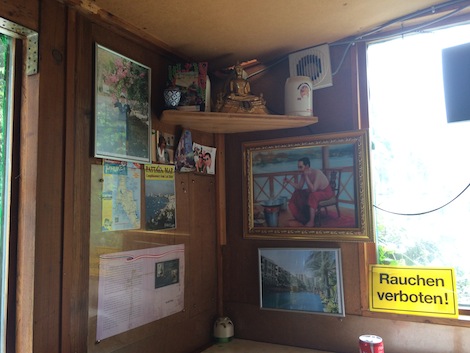
Thanks to Michael Obrist and Nora Amelié Sahr, I had really good food in another idiosyncratic space: Donna's Thaiküche.
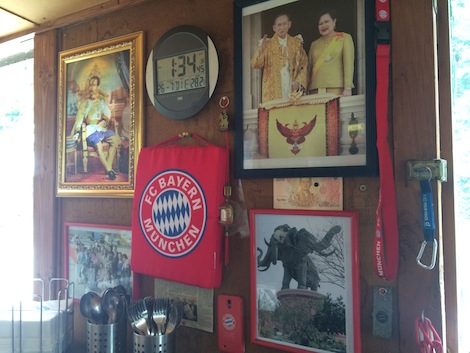
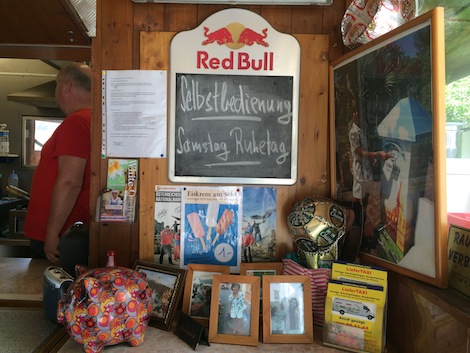
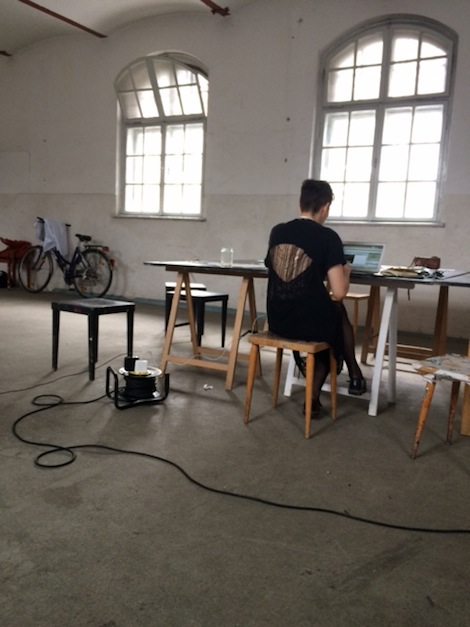
And here is me writing (photo by Nora Amelié Sahr):
Life of a painting

"How do you arrive to the work?"
Charlott Weisse: I think arriving to the work can be even more important than finishing a work. It’s a state that you’re in. A mental space that allows you to question. Wait, I’ll start again.
G: Just take your time… Is it like, let’s say, approaching to a person?
C: For me, it is the question of from which place do you paint? Where does your voice come from? What do you want to say? What is important for you? What kind of an honesty do you put in? It is in relation to the other question: What does a painting do to the others? Also to yourself... Painting is so revealing. Not frightening, but it’s sometimes hard to be really honest when painting, especially if you would like to break borders, get out of the comfort zone. My work, for example, deals a lot with personal narrations. Often they can be encrypted or fragmented. I find interesting what Francis Bacon tells about his work. He’s talking a lot about a certain distinction between figuration and figural.
He doesn’t paint figurative, but goes towards the purely figural, through abstraction and extraction . Almost literally he says that "some paint“ (talking about the figural) acts immediately on the nervous system and other paint tells you the story via a long diatribe through the brain". How is painting more direct? Back to the question: it is also how you listen to the work. You arrive to something that also takes you further from that point. Painting is something that is very active and performative, but at the same time you have to really listen to the work. It’s like a ping-pong game that requires concentration. In a way, you think through the work… I don’t know if I’m too vague about the answers.
And… the life of a painting… It’s beautiful that Varda wrote down this question. It means that a painting has a life of its own. A painting is born, when an idea is born. For a while you accompany this painting and when you are finished with working on, it is free. I don’t know who said that but we talked about this philosophical idea of existence in relation to perception. Something only exists as long as we see or acknowledge. The thing dies as soon as it is not regarded any more.


