The City is Our Factory
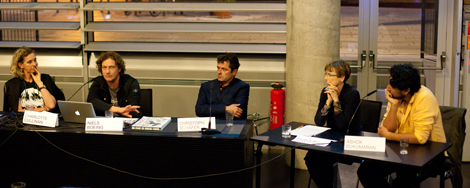
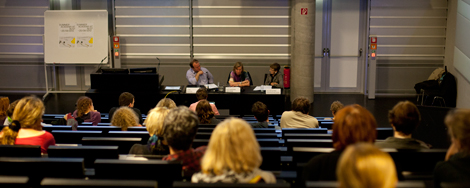
The second evening in the Summer Academy’s lecture series provided a detailed discussion about the role, construction and significance of the city and urban spaces in artistic production.
Christoph Schäfer began proceedings in his own inimitable style. Warning us that his talk would be “dry and boring”, he promptly climbed on to a table and proceeded to bark. A short song followed. Dismounting, he then began a sweeping overview of the urban and art. Drawing on Henri Lefevre, Schäfer outlined historical developments, ideas illustrated in his own work, especially the Lamentation for Ur. This suggested various definitions of the city, and art’s role and presence within it. He presented us with a new drawing, From Factory to Facebook, which illustrated new forms of collective production and subjectivity. Competing definitions of participation in art abound, as do constructs of the city. Salzburg, he suggested, is typical of the “image city”: it is “the last place where the bourgeoisie is really safe”.
Charlotte Cullinan described a specific project she undertook in Newcastle with Jeanine Richards. They wished to explore the city as production space, taking an “anti-avant garde” position: for them, “art is not about rational processes” but the responses of the viewer. Two evening events were held at the Laing Gallery, beginning with an invitation which was a “love letter to our audience”. The events involved constructing a “laboratory for viewing”, establishing a questioning nature to the status of the art objects. Cullinan showed photographs of the participants/audience, as they themselves viewed and interacted with the artworks. The experimental nature of the work disturbed some: “a lot of people got very cross with us”. This, perhaps, is the greatest sign of success.
Ashok Sukumaran introduced us to some of the work he has been doing with Shaina Anand, as part if the project CAMP, a space and work studio in Mumbai. He describes himself as an “archaeologist of media”, seeking to extend through the “networks which suck at us”. He has been thinking about the process of “temporalising the city”, utilising film and other media often produced involuntarily, with and without purpose. Through these media, he has been seeking ways to access or substitute intimacy within the city. The abundance of information left over by digital technology allows insights and access, in a virtual “positive voy*urism”.
Niels Boeing is a writer and thinker from Hamburg. He began by posing the question: what comes after capitalism? In the postindustrial age, we are still producers, but the scenes of production have merely moved from the western city to other centres. The information age has left many able to operate, but not understand on a structural or technical level, rendering them subject to others who do possess such knowledge. However, many are trying to reclaim the role of producers, with the rise of open source hardware, allowing individuals to gain this power. “Fab labs” have sprung up all over Europe, places where “manufacturing meets art”, a new sort of factory where individual needs and desire, not profit, predominate.
The ensuing discussion considered many of the issues centering around the notion of the city as a centre or a focus of production. A key point of contention was the idea of “reception becoming production”, and the question as to whether we should take a “ground up” or a “sideways view” when thinking about audiences as participatory.
Revealing and Revelling in the Process

After an absence of a few days the Summer Academy blog returns with a few summaries of what’s been going on here in Salzburg.
On Monday Lin Cheung, a jewellery artist from England, discussed her work and her interest in the process of creativity and production. All too often jewellery is seen - and perceived - as a finished product. There is a traditional reluctance amongst artists to explain processes, fearing that to do so will remove the mystique which surrounds a “work” of art.
Instead, Lin wants to focus on the possibilities of a work, the potentials which lie in the uncompleted. In this way she is removing the focus on finality: she doesn’t want to realise the end product to soon, as this not only may stifle creativity, but also overlooks the importance of the process itself. In effect, she wants to “skirt around the idea of jewellery”
She talked about various projects in order to highlight process, encouraging people to consider both process and unfinished object, and thus prompt very different ideas of what the finished product will - or could - be. In previous exhibitions Lin invited viewers to write what they thought the objects were, investigating the idea that the objects, although made, are not yet defined. This interactivity involves the viewer in the process, raising the question of the relationship between object and viewer. In all art, viewers play an interpretive role, but the conventional set up of the exhibition all too often obscures the viewer’s relationship with the object, establishing a barrier between them. However, by focusing on process and on the unfinished object, we are empowering the viewer and allowing a much wider definition of what constitutes “art”.

History and the Studio
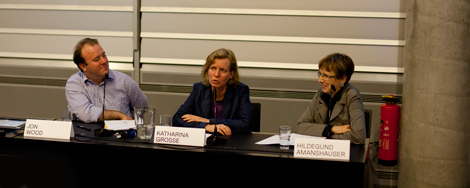
Last night saw the first in our evening Lecture and Discussion series, at the Unipark in Nonntal. We began with a consideration of the Summer Academy’s theme of the “Studio” from two different, but complementary, perspectives.
Jon Wood, Research Curator at the Henry Moore Institute in Leeds, provided us with a historical overview, as seen in the photographs of sculptors’ studios from the late nineteenth to the mid-twentieth centuries. The studio, for many, is a curiosity, a physical representation of an artist’s mind, the site of creative endeavour. Its photographic representation, often staged and contrived, can be an artistic statement in its own right, as the studio functions as a stage upon which the protagonist performs his role as “artist”. Yet if such images undermine the notion of the camera as purveyor of “truth”, these images do allow us to see how artists conceived of their studios, and how they wanted these places, and themselves, to be seen. In this sense they remain a valuable insight into what studios were, and how they have been constructed, in the imagination of the artistic community.
Katharina Grosse, a Berlin artist, continued the evening with a personal reflection on the role and meaning of the studio. She developed these ideas - examined in depth in her 2009 volume, Wish I Had a Big Studio in the Center of the City - in terms of the convergence of physical and pictorial space in her work. This was amply illustrated with recent “in situ” examples, such as Blue Orange, her 2012 transformation of the train station in the Swedish town of Vara. Her studio, like those of many of the artists described by Jon Wood, is itself a statement of her art. It was built according to her needs - providing a contrast with the many artists whose studios were built, and thus are restricted by, the needs of previous occupants. Located in the centre of Berlin, it allows her to be visible - to be seen - as an artist, generating the performative aspect which the very construct of the “Studio” embodies.
The lectures were followed by a lively discussion, in which the audience engaged with the speakers, developing the themes in new directions such as psychoanalytical readings, and drawing connections between the two talks.
A Utilitarian Art
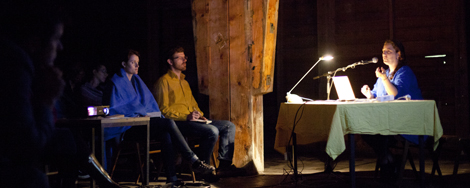
In Hallein yesterday we were introduced to the work of the Immigrant Movement International. The movement’s founder, Tania Bruguera, presented us with the background and ideology which led to this project, and the her belief in art as a political tool.
Bruguera is a great believer in what in her native Spanish is titled Arte Útil. It is a notion which it difficult to translate - in English it has been rendered as “Useful Art”, but this perhaps does not do it justice. It is an art which refuses to disassociate itself from social and political responsibility, an art which stands for much more than itself. It is an engaged art which, in the tradition of Emile Zola, stands as an aesthetical-political authority. It is art which attempts to achieve. It is utilitarian in the original meaning of the word.
Based in New York, the IMI seeks to empower immigrant populations, redefining the concept of the “citizen” within a twenty-first century context. Through programmes of workshops, classes and events, immigrant communities are encouraged to find and generate links between the creative and the practical. Invited artists work with the community, while the project is supported by a network of volunteers, bridging gaps between difference. In her work art does not merely serve a political purpose: it is a political act.
Ancient Lamentations in the Modern City
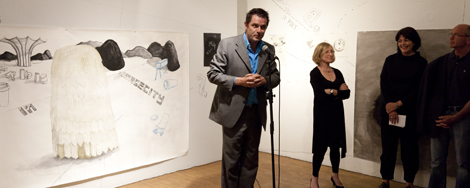
Last night we witnessed the opening of Christoph Schäfer’s astounding exhibition, Lamentation for Ur, at the kunstraum pro arte in Hallein. Introduced with a graceful and touching elegance by Jo Ractliffe, Schäfer himself was brief and self-effacing, exuding an easy humour which belied, and thus intensified, the import of his work.
The exhibition takes as its starting point the ancient texts composed after the conquest of the Sumerian city of Ur in the third millennium BC, inspiring a meditation on the very concept of the “city”. We are presented with a series of images evoking and this ancient catastrophe and its very modern relevance, forcing us to rethink how the past can expose the ways in which the present is constructed.
Schäfer’s art is very contemporary - in that it reflects and engages with urgent political and economic concerns - but also develops longstanding questions of place, symbol, and image. There are elements of key thinkers evident, such as Brecht and Benjamin; and there is also a parallel with the Revolutionaries and Romantics of previous generations, for whom the ruins of antiquity challenged and inspired modernity. Yet such simplifications can barely do justice. There is much to see and to ponder here.